
A'udhu billah!
Protection from the many faces of Iblis

Ramadan has left us for another year and the devils have come out of their cells having been chained for the last 30 days through the blessings of the month. Iblis and his cronies will now be working overtime to distract us from the love and worship of Allah and to seduce us into disobeying Him.
But how is it, that this ends up happening? Few Muslims actually have a resolute intention to disobey Allah but somehow we find ourselves in situations that are wrong.
So I thought that it would be useful for me and those who would like to share a moment to talk about Iblis (shaytan, satan, the devil) and his minions so that we are a bit more aware of an actual force that is actively working against us to bring about our downfall. As the Most Generous has said,

So here is a story and some narrations that shed light on some and I say some of his wily ways:
Shaytan and the woodcutter
Now you must understand, that in the days of old when firewood was gathered by hand, and men knew the strength of their own shoulders, there lived a most simple and pious woodcutter. Every morning, with the dew still on the grass and the birds rubbing sleep from their eyes, he would swing his axe over his back and go out into the woods, chop-chop-chopping for his daily bread. He asked little, earned fairly, and returned with arms full and heart clean.
But it happened one morning—just so—that the woodcutter heard a whispering thing from a travelling trader who had passed through the village, and the whisper was this: “The people in the next village have begun to bow and scrape before a great tree, and they call it a god!”
Now this boiled the blood of the woodcutter, who feared none but Allah, and loved none but the Truth. So he took up his axe, sharper than serpent’s tooth and truer than an old friend's advice, and he said to himself, “I shall cut down this idol-tree, and let the people see that no bark or branch has power to bless or curse.”
And off he marched.
But O my heart, who should he meet upon the winding road between the two villages but a curious fellow indeed? He had eyes that danced like candlelight and a smile that didn’t reach his ears. He leaned against a tree—not the tree, but a tree—and said ever so smoothly:
“Where do you wander with such purpose, O man of wood and will?”
“To chop down the false god that men bow before!” replied the woodcutter, and he thumped his axe for good measure.
“Why such bother?” said the stranger, soft as a snake’s hiss. “Let them worship bark and twig if it pleases them. You go back and cut honest firewood. This is not your affair.”
Now the woodcutter did not like the sound of this at all, no no. It rang false like cracked brass. So he said, “Out of my way, for I go to please my Lord!”
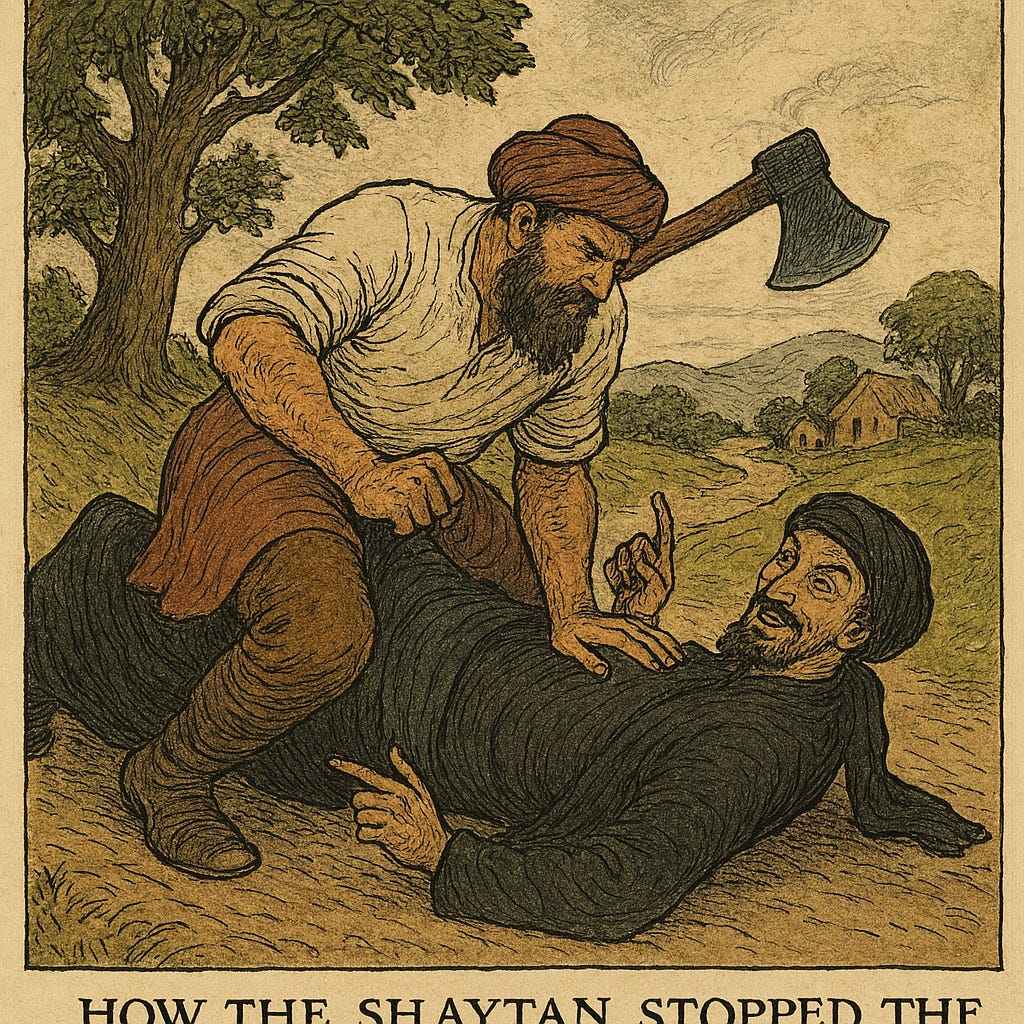
And then they wrestled. They hustled and tussled but the woodcutter, who had Truth on his side and no coin in his pocket, was strong with his faith, and bam! he pinned the stranger to the dust, just like that.
Now the fellow, still smiling, though his robes were dusty and his pride a little dented, said, “You’ve wrestled well, O tree-feller. But let me tell you a secret. You're tired, and you’ve earned no coin today. Go home. Sleep. And when you rise for your morning prayer, look beneath your prayer mat. You shall find silver there—every day, just enough.”
Well, the woodcutter scratched his beard and thought: “I am tired, and the tree will still be there tomorrow.” So home he went.
And just so, when the sun rose golden and the call to prayer filled the air like a gentle bell, he rose, he prayed, and he peeped beneath his mat—and what should he find but coins? Coins! Real, round, rattling coins!
And every day, it was just the same.
So he did not go back to the tree.
He said, “I shall do it tomorrow. Tomorrow, yes.” But tomorrow is a tricky creature and often slips away.
Days turned to weeks, and the fire in his belly cooled. He grew soft. He grew sleepy. He grew accustomed to ease. Until one morning, he prayed and peeped, but there was nothing under the mat. Not even a farthing.
He jumped up, red in the face and wild in the beard.
“That trickster! That cheat! That no-good coin-giver!” he thundered, and he grabbed his axe, which had grown cold from idleness, and he stomped down the road like a thundercloud in boots.
And there—as before, so again—was that same smirking man, still leaning, still lounging, as though nothing had changed.
“Out of my way!” shouted the woodcutter. “You lied to me, and now I will do what I should have done weeks ago! That tree shall fall!”
“Oh?” said the stranger. “But why the rush, friend? What drives you now?”
“Trick me once—!” growled the woodcutter, and they fought again. They wrestled and they wriggled, they kicked and they scuffled, but—oh my! This time the stranger threw him down as easy as a boy tosses a ball.
The woodcutter lay in the dust, dazed and defeated, his axe beside him.
“How?” he gasped. “You were weak before!”
“Ah,” said the stranger, smiling that not-quite-smile. “That time, you fought for Allah. This time, you fought for gold. The strength of faith is greater than the strength of greed, and today you came with no armour of sincerity.”
And with that, the stranger faded like smoke in the wind.
And the woodcutter—wiser, wearier, and still with no coin—picked up his axe and walked home, slowly.1
Iblis’ Repentance
One day, while walking through the desert with the sun bright above him and the sand shifting below, the Prophet Musa, peace be upon him, was met by a visitor. Not a traveller, nor a seeker of truth, but Iblis—the one cast out, the one who once stood with the angels and refused.
“I have come to speak,” said Iblis, his voice smooth and solemn. “You are the one who speaks with Allah, and Allah speaks with you. I have done wrong, I know. But I wish to repent. Will you ask your Lord if He will forgive me?”
The Prophet Musa was taken aback. This was not a request he had ever expected. Yet, if the deceiver himself wished to turn back, what might that mean for the world?
So Musa raised his hands and asked Allah: Is there a path for Iblis, should he wish to return? And Allah answered.
The Prophet Musa returned with the news, whilst Iblis waited expectantly. ‘Allah will forgive you, but you have to do something first.’ Iblis’ hopes were raised, his years of enmity and sins, his misguidance and evil, were they all to be forgiven by Allah? How merciful is He?
The Prophet Musa continued, ‘Bow down to the grave of Adam and Allah will forgive you.’ As soon as Iblis heard the name of Adam his expression changed. His face darkened and his pride flared up like a fire.
‘I refused to bow to him when he was alive,” he scoffed. “And now you want me to bow to his grave?’
And with that, he turned away.
But before he left, he looked back at the Prophet Musa and said, ‘You have done me a favour by interceding for me, Musa,’ he said. ‘So let me do you one in return.’
There are three moments in life when you should remember me,’ Iblis continued. First—when you are angry. In those moments, I run through your veins like blood, pushing you to say and do what you will regret.
Second—when you stand in battle. That is when I whisper in a man’s ear, reminding him of his wife, his children, his home—anything to make him turn and flee.
And third—when you are alone with a woman who is not lawful to you. Because I will be your messenger to her and her messenger to you.’
Then, with nothing more to say, Iblis disappeared into the wind, leaving Musa alone in the desert, with nothing but his warnings lingering in the air.2
A skinny shaytan met a fat shaytan
Abu Hurayrah (may Allah be pleased with him) said:
"The devil of a believer and the devil of a disbeliever met. The devil of the disbeliever was well-fed, fat, and smooth, while the devil of the believer was weak, dishevelled, dusty, and naked.
The devil of the disbeliever asked the devil of the believer: 'What has made you so emaciated?'
He replied: 'I am with a man who, when he eats, he says Bismillah (in the name of Allah), so I remain hungry. When he drinks, he says Bismillah, so I remain thirsty. When he wears clothes, he says Bismillah, so I remain naked. When he applies oil (to his hair or body), he says Bismillah, so I remain dishevelled and untidy.'
The devil of the disbeliever said: 'But I am with a man who does none of these things, so I share in his food, his drink, and his clothing.'"3
Shaytan and his Children
Imam Mujāhid4 said
"Iblis laid five eggs, from which emerged: Zalanbūr, Dasim, Thabr, Miswāṭ, and Al-A‘war.
As for Al-A‘war, he is responsible for fornication (zinā).
As for Thabr, he is responsible for calamities (maṣā’ib).
As for Miswāṭ, he is responsible for spreading false news (akhbār al-kadhib), casting them onto people's tongues so that they circulate baseless rumors.
As for Dasim, he is responsible for homes: if a man enters his house without saying Bismillāh, Dasim enters with him; and if he eats without saying Bismillāh, Dasim eats with him. He also makes him notice and become disturbed by household matters, causing discord.
As for Zalanbūr, he is responsible for the marketplaces (aswāq), placing his head between the sky and the earth in every market."5
These ancient forces have not vanished; they have only evolved into full blown demonic governmental departments.6 But their goal remains unchanged—to pull us away from the remembrance of Allah and into disobedience.
However, armaments are available! We have been given a Prophet ﷺ who is in the words of the Merciful, ‘Grievous to him is what you suffer; concerned over you and to the believers he is kind and merciful,’ and who said: “Verily, the believer will wear down his devils by obedience to Allah, just as one of you wears down his camel on a journey.”7
So every morning and evening, make it a habit that after your Fajr and Maghrib prayer to recite:

For the Beloved of Allah ﷺ, said:
"Whoever says, before leaving his place and before moving his legs after the Maghrib and Fajr prayers:
'Lā ilāha illa Allāh, waḥdahu lā sharīka lahu, lahu al-mulku wa lahu al-ḥamdu, biyadihi al-khayr, yuḥyī wa yumīt, wa huwa ʿalā kulli shayʾin qadīr' (There is no god but Allah, alone, without any partner. To Him belongs the dominion and to Him belongs all praise. In His Hand is all goodness, He gives life and causes death, and He has power over all things) ten times,
Ten good deeds will be recorded for him.
Ten sins will be erased from him.
He will be raised by ten ranks.
It will serve as a protection from all harm.
It will be a shield against the accursed Shayṭān.
No sin will reach him except shirk (associating partners with Allah).
And he will be among the best of people in deeds, except for someone who surpasses him by saying it even more.”8
This dhikr is a powerful shield, no doubt. But if we really want to level up, it comes down to purification—that's the real fortress, where shaytan finds no doors of vices left open to enter into our hearts. For as long as we are carrying vices, we are creating doors of entrance for the devil. Recitation needs purification. Like Imam al-Ghazali said, you can eat as much medicine as you want but if you’re still drinking poison then the problem is with you. But, that’s a deeper topic… we’ll save that for another time.
I believe this story is from Mawlana Rumi which I heard from Shaykh Muhammad Sadiq. I took some liberty with the retelling of this story where the style has been changed to a more Kipling tone. (I’ve been teaching Kipling to my Year 5s)!
The meaning of the narration is from the Hadith of the Prophet ﷺ as recorded by Ibn Asakir.
Hadith
The famous Quranic commentator from the generation of the Tabieen and the student of the Companion Abd Allah ibn Abbas, may Allah be pleased with them.
Recorded byIbn Abi al-Dunya in Makā'id al-Shayṭān.
In today’s world, the five devils that Iblīs "hatched" have adapted into powerful, ever-present forces shaping society.
Zalanbūr, the shayṭān of the marketplaces, now thrives in capitalism and unchecked greed. From corporate CEOs to the everyday person chasing wealth for wealth’s sake, he fuels a system where human worth is reduced to economic output.
Miswāṭ, the master of falsehoods, has found his perfect medium in social media. Instagram filters distort reality, X (Twitter) amplifies outrage, YouTube and news outlets manufacture narratives, ensuring that misinformation spreads like wildfire.
Al-A‘war, the corrupter through fornication, no longer lurks in the shadows. He runs a smooth marketing campaign, making immorality accessible at the swipe of a finger, rebranding sin as empowerment.
Dasim, who sows discord in homes, has mastered the art of ingratitude. He whispers dissatisfaction into hearts, making people blind to their blessings, turning small inconveniences into bitter conflicts.
Thabr, the one who exploits calamities, ensures that when hardship strikes, people despair rather than turn to Allah.
Abu Huraira in the Musnad of Aḥmad
Abd al-Raḥmān ibn Ghanm, in the Musnad of Ahmad
Allah Yubarikk akhi.
Subhanallah ❤️