
On Reciting the Quran
Chapter 6 of Imam al-Haddad's Book of Assistance

It is related that Imam Ahmad bin Hanbal saw his Lord in a dream. (Yes that is possible, but let us leave that explanation for another time) and he asked Allah, ‘O Allah what is the best action by which the Close Ones draw close close to You? Allah the Exalted replied, ‘By My Speech, (Quran)’ Imam Ahmad asked, ‘With understanding or without understanding?’ Allah the Exalted replied, ‘With understanding and without understanding.’1
The scholars are in agreement that the best act of remembrance besides the obligations is the recitation of the Quran.
The Prophet of Allah ﷺ said,
A man who reads the Qur'an and then feels that someone else has been given more than what he himself has been given, has indeed considered small that which Allah has considered great.
The great scholar and saint from the Tabi-Tabieen, Sufyan al-Thawri said,
‘When a man reads the Qur'an, the angel kisses him between his two eyes.’
Imam al-Haddad in the sixth chapter of his Book of Assistance advises that an essential means of success in the hereafter and closeness to Allah is to have a regular recitation of the Quran along with the etiquettes and reverence that it due to it.
You must have a wird of recitation of the Mighty Book to be read every day. The least you should do is read one juz' (one thirtieth of the Quran) so that you complete it once a month, and the most is to complete it every three days.
The key point here is to make the recitation of the Quran regular. People will differ in their ability as to how fluently and regularly they can recite but everyone has to start somewhere. For some, it may be one juz, for others it may be a page and for others it may be half a page but the key to success is making its recitation a regular habit. Without committing to some portion of the Quran; the purpose of the Prophet of Allah which was to convey the divine message is neglected; if not belittled.
Children tend to have a natural affinity towards the Quran. Millions of Muslim children spend something of their week in learning its recitation and can be seen rocking backwards and forwards because of the purity of their souls, their spirits at ease with its recitation, but when we come to the teens and adulthood, this begins to change. Other matters become a priority and the ego now creates a resistance in its recitation.
Steps to begin recitation
Barriers of what we have seen and said, create an aversion to recitation and the Prophet has advised his Ummah to purify themselves with wudu by which the tar of sins and the weight of worldliness is washed away: the body becomes lighter and the soul is affected. A further level of cleansing in the recitation of Istighfar then welcomes the reciter.
Focussing on particular surahs of recitation is easier for the ego to handle, especially when he uses single book Surahs rather than the whole mushaf. For example reciting Surah Yasin or reciting a juz from a booklet; Imam al-Haddad mentions which surahs should be recited towards the end of the chapter.
He, may Allah be pleased with him, continues
Know that great merit attaches to reciting the Quran and an influence in illuminating the heart. The Messenger of God, may blessings and peace be upon him, has said: The best of my nation's devotions is the recitation of the Quran. And Ali, may God ennoble his face, has said: ‘The one who recites the Qur'an while standing in prayer receives one hundred rewards for each letter; the one who recites it outside the prayer but in a state of ritual purity receives twenty five rewards for each letter; and the one who recites it without ritual purity receives ten rewards for each letter.'
Each recitation has an affect in the hereafter as well. The Prophet of Allah ﷺ has informed us that the Quran will appear in a person’s grave and will accompany them in the Hereafter. "In the Hereafter no intercessor will be superior in rank in the estimation of God (exalted is He) to the Qur'an - not [even] a prophet, nor an angel, nor anyone else."
Imam al-Haddad mentions:
Beware of concentrating, while reciting, on reciting a large amount to the exclusion of reflection and correct recitation. You must reflect and comprehend while you recite; slow, melodious recitation will assist you in this. Feel in your heart the Magnitude of the Speaker (Transcendent and Exalted is He!) and that you are before Him, reciting His Book to Him, in which He addresses His commands, prohibitions, counsels and exhortations to you. When reading verses on unification and glorification be full of reverence and awe, when reading verses of promises and threats be full of hopeful expectations and apprehension, and when reading the commands and prohibitions be thankful, acknowledge your shortcomings, ask for forgiveness and determine to show ardour.
This was the Sunnah of the Prophet, may Allah bless him and grant him peace. The holy tongue of the Prophet was the key which opened the recitation of the Quran for all of us. Had it not been for the strength of his holy heart and the purity of his holy tongue, the Quran would have remained with Allah and the creation would not have heard its recitation.
Although it may be difficult for a non-Arab speaker to be able to identify which of these verses are verses of encouragement (targheeb) and verses of cautioning (tarheeb), having a sense of the grandeur of the Speaker is what is intended.
The student who recited before Allah
It is mentioned that there was a student of knowledge who would would try to stay awake at night in order to recite the Quran but would end up falling asleep. He complained of this to his teacher and his teacher advised him to recite the Quran tonight whilst imagining that he is reciting to his teacher.
The following morning his teacher asked him as to how his recitation went. The student said that he was able to recite a third of the Quran but then fell asleep. His teacher then advised him that this time, when he recites the Quran, to recite it whilst imagining that he is reciting to the Prophet of Allah ﷺ.
The following morning his teacher as him as to how his recitation went. The student said that he was able to recite half of the Quran but then he fell asleep. His teacher then advised him that this time, when he recites the Quran, to recite it whilst imagining that he is reciting it to Allah ﷻ.
The following morning, the student did not come to school. He was nowhere to be seen. His teacher asked the other students as to where he was and they said that he had not left his house and was ill. So the teacher went to visit him and found him curled in bed crying. His teacher asked him as to how his recitation went last night. The student replied that when he imagined he was reciting the Quran before Allah, he couldn’t even get past Surah al-Fatiha. He continued weeping and after a few days he passed away.
The glaring disparity between the majesty and generosity of Allah and His right, in comparison to the disobedience and heedlessness of the servant became an opening for this student which ultimately took his spirit.
Imam al-Haddad further mentions
Know that the Qur'an is the ocean wherefrom the jewels of knowledge and the treasures of understanding are extracted. Any believer who is granted the way to understand it, his Opening [fath] becomes permanent, his light complete, his knowledge vast, and he never tires of reading it night and day, for he has found therein his goal and his purpose. This is the quality of the sincere seeker. Shaykh Abu Madyan, may God be pleased with him, has said: 'A seeker is not a seeker until he is able to find in the Quran everything that he desires.'
This is the state of the Muntahi-those who are at the end of their spiritual path or who have completed it. Sayyida Nafisa had recited 6000 recitations of the Quran in a grave which she had dug for herself. Likewise, when the servant of Rabia al-Basri would say to her on beautiful days, ‘Come out and see the beauty outside.’ She would reply with, ‘Come in and see the beauty inside.’ Imam al-Haddad once said, ‘I can see 70 doors of knowledge that are contained within the verse of ‘Lord grant us the good in this life and the good in the next life.’ Imam Ahmad Mashhur al-Haddad once spent 15 days explaining the verse of ‘You alone we worship and You alone We ask for help.’ The Quran is the speech of Allah to which there is no equivalent.
As for those who are at the beginning of the path. The Masters advise that because they are still controlled by their egos and mix good and bad actions, they need to seek a lot of forgiveness, recite salawat and read tahlil (La ilaha illa Allah) for the purification of the soul. At the same time they should not neglect a portion of the Quran.
Imam al-Haddad concludes the chapter by mentioning specific surahs which should be recited daily
Be careful to read those suras and verses which are recommended in the Sunna at particular times.
Recite every night
1. Surah al-Sajda (Surah 32),
The Messenger of Allah ﷺ would not sleep until he had recited Surah al-Sajdah and Surah al-Mulk.2
2. Surah al-Mulk (Surah 67)
The Messenger of Allah ﷺ said, ‘A surah from the Quran of 30 verses argued for its reciter until it entered him into Paradise.’3
3. Surah al-Waqi'a (Surah 56)
‘Whoever recites Surah al-Waqiah every night will never be afflicted with poverty.’4
4. The last two verses of al-Baqara (Verses 285 and 286)
‘Allah wrote a book two thousand years before He created the heavens and the Earth, and in it are the last two verses of Surah al-Baqarah. The devil will not come near a house in which they are recited for three nights.’5
On specific days:
1. Surah al-Dukhān (Surah 44) on Sunday and Thursday evenings,
‘Whoever recites Ha Mim al-Dukhan at night will awaken with 70,000 angels seeking forgiveness for him.’6
2. Surah al-Kahf (Surah 18) on Thursday night and Friday.
‘Whoever recites Surat al-Kahf on Friday will have a light between this Friday and the next.’7
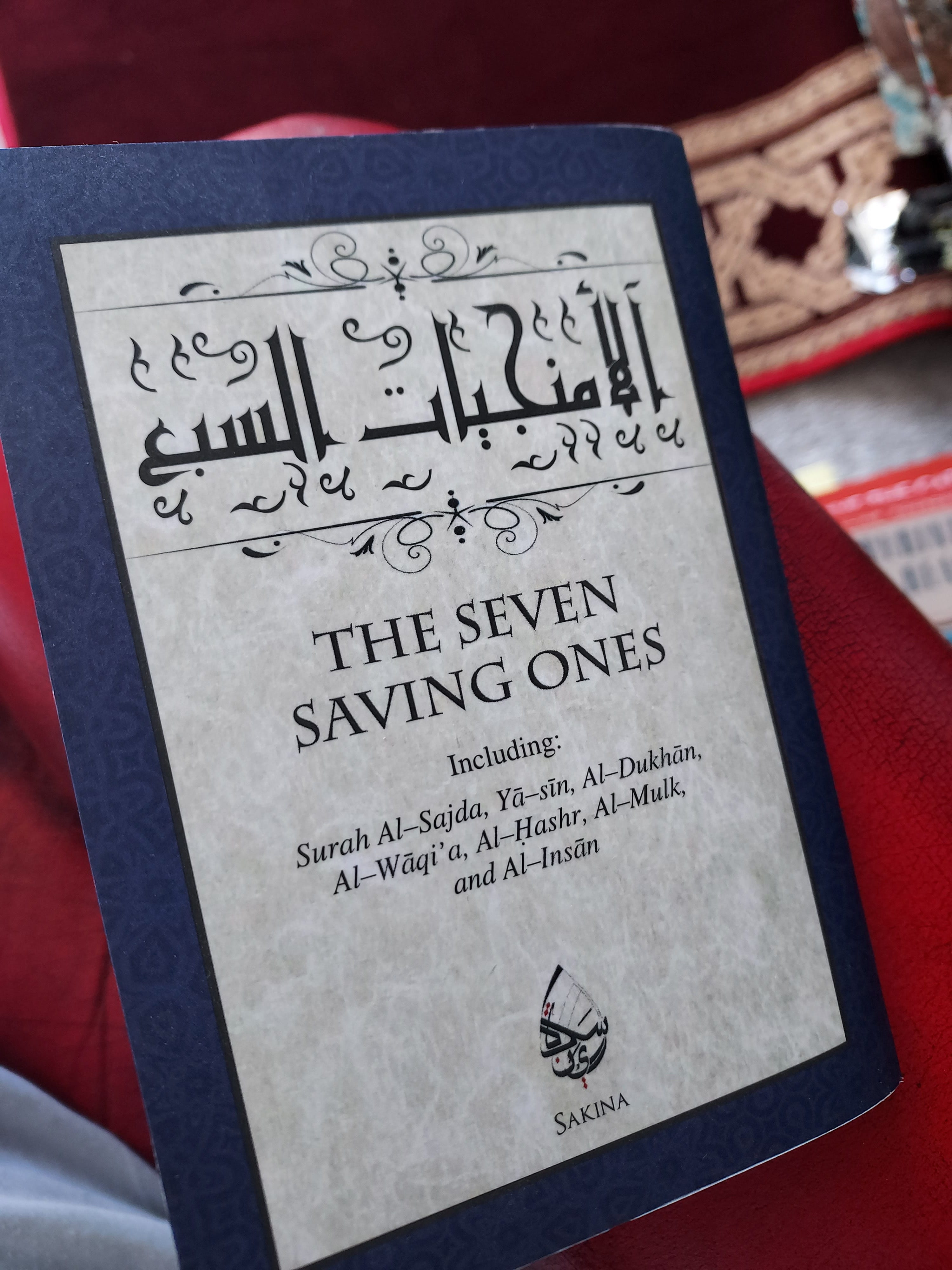
3. Read, if you can, the Seven Saving Ones every night, for their merits are great.
(Surah al-Sajdah, Yasin, al-Dukhan, al-Waqia, al-Hashr, al-Mulk, al-Insan)
Morning and evening recite:
1. The first few verses of Surah al-Hadid (Surah 57:1-6)
2. The last few verses of Surah al-Hashr (Surah 59:21-24)
3. Surah al-Ikhlas, Surah al-Falaq and Surah al-Nas three times each.
4. Surah al-Ikhlās, Surah al-Falaq, Surah al-Nas Ayat ul-Kursi and Surat al-Kafirun immediately before going to sleep, making these the last thing that you utter.
And God says the truth, and He guides to the way.
Ibn al-Jawzi, Ibn al-Jazari and al-Dhahabi.
Related from Jabir bin Abdullah and recorded in Bukhari and Muslim.
Related from Anas ibn Malik and recorded in Tabarani.
Related from Ibn Masud and recorded in Ahmad and Bayhaqi.
Related from Tirmidhi and Imam Ahmad.
Recorded in Tirmidhi
Related from Abu Said al-Khudri and recorded in Sunan al-Kubra.